

If you have typed "dates supplier Malaysia" or its Malay twin, "pembekal kurma Malaysia", into a search bar, you probably want three things: to know which dates are worth buying, what they cost, and what to check before you hand over money for a few kilos or a few hundred. This piece covers all of that in a plain order. It starts with where the fruit comes from, then what is inside it, how it ripens, what a real price list looks like, and how to cook with and store what you buy. For a first look around this site, the home page is the place to start.
Where the dates you buy here come from
Malaysia has no commercial date-growing trade. Every date sold in the country is imported, so any dates supplier you deal with here is handling fruit from abroad. These are the main varieties on the price list used later in this article, with their origins.
| Variety | Origin | What it is like |
|---|---|---|
| Ajwa (also sold as Kurma Nabi) | Madinah, Saudi Arabia | Small, roundish, near-black, finely wrinkled skin, soft |
| Safawi | Madinah region, Saudi Arabia | Longer than Ajwa, dark brown to black, soft and chewy |
| Sukari | Al-Qassim, Saudi Arabia | Golden-amber, very sweet; sold soft (rutab) or drier |
| Medjool | Originated in Morocco; the Medjool packs in the price table below are labelled Palestine | Large, very soft, rich caramel taste |
| Mazafati | Bam, Kerman province, Iran | Dark, very soft, high moisture; needs refrigeration |
| Mariami | Iran | Dark, semi-dry, chewy |
| Deglet Noor (kurma tangkai when sold on the stem) | Tunisia / Algeria | Golden, translucent, semi-dry |
The range of possible varieties is far wider than any shop shelf. The FAO handbook Date Palm Cultivation (Plant Production Paper 156, revised 2002) lists how many varieties had been described in different countries: 400 for Iran, 370 for Iraq, 250 for Tunisia and 244 for Morocco.
Medjool has a long trading history. FAO says it comes from the Tafilalet area of Morocco, where it was the main export date from the 17th century and was sold in fancy gift boxes for Christmas in Paris, Madrid and London. It was later introduced to the USA (1927) and Israel (1934). If you want more on Medjool and its many spellings, there is a separate piece on Kurma Majol and Medjool.
What is in 100 g of dates
The USDA FoodData Central database has SR Legacy records (last updated April 2019) for two of the varieties above. Here are the main figures per 100 g.
| Per 100 g | Medjool (FDC 168191) | Deglet Noor (FDC 171726) |
|---|---|---|
| Energy | 277 kcal | 282 kcal |
| Carbohydrate | 75.0 g | 75.0 g |
| Total sugars | 66.5 g | 63.4 g |
| Sucrose | 0.53 g | 23.8 g |
| Dietary fibre | 6.7 g | 8.0 g |
| Protein | 1.81 g | 2.45 g |
| Potassium | 696 mg | 656 mg |
| Magnesium | 54 mg | 43 mg |
| Calcium | 64 mg | 39 mg |
| Phosphorus | 62 mg | 62 mg |
| Vitamin B6 | 0.249 mg | 0.165 mg |
The two look alike on energy and carbohydrate. The sugar mix is where they part ways. In the Medjool record almost all the sugar is glucose (33.7 g) and fructose (32.0 g), with barely any sucrose. Deglet Noor carries 23.8 g of sucrose per 100 g. Fat is 0.15 g for Medjool and 0.39 g for Deglet Noor.
These are composition figures, not health promises. They tell you what is in the fruit. They do not tell you what it will do for you, and this article makes no such claim.
Ripeness words on a supplier's list
Two words on a date list are worth understanding: rutab (spelled "Rotab" in the pack names on the list below) and tamar. FAO describes five stages of date development, called Hababouk, Kimri, Khalal, Rutab and Tamar. Rutab is the soft, fresh-ripe stage. Tamar is fully ripe and drier.
The difference matters for buying. FAO writes that at the rutab stage, apart from a few varieties, the fruit is very sweet, but unless it is cold stored it quickly turns sour and loses its commercial value. Tamar is the opposite. FAO says that once protected from insects, tamar can be kept without special precautions over longer periods, and calls it ideal for marketing as "dried" dates.
Mazafati, sold as rotab, is very soft and needs refrigeration. It is cold-stored and sold year-round, so seeing it outside Ramadan is normal.

What prices look like, small packs vs 5kg
Whichever pembekal kurma Malaysia you end up dealing with, a useful supplier list names the variety, the grade, the pack weight and whether it is in stock. The table below uses current prices from one Malaysian wholesaler, checked in November 2026. Each row sets a smaller pack beside a 5kg pack of the same variety. The grade names inside each pair are not identical, so read them as two products, not one product in two sizes.
| Variety | Smaller pack | 5kg pack | 5kg pack per kilo |
|---|---|---|---|
| Ajwa | 1kg Ajwa A 2026, RM31 | Ajwa Premium A No.1 (Small) 2026, RM115 | RM23 |
| Safawi | 1kg Safawi A, RM35 | Safawi Premium A No.1 (Small) 2026, RM95 | RM19 |
| Mariami | 1kg Mariami AAA, RM40 | Mariami AAA VIP 2026, RM148 | RM29.60 |
| Medjool | 900g Medjool Palestin Jumbo box, RM70 | Medjool Palestin Premium Jumbo 2026, RM280 | RM56 |
All eight packs in that table were in stock when checked. In each of the four pairs, the 5kg pack works out cheaper per kilo than the smaller pack beside it. Safawi shows it clearly: RM35 for the 1kg pack against RM19 a kilo in the 5kg pack.
Not everything was available. On the same list, the Rotab Mazafati AAA pack (12 packs of 600g, RM86) was out of stock, while the Rotab Sukkary Premium 3kg pack (RM63) and the Deglet Noor Bertangkai semi-dry pack (12 packs of 400g, RM88) were in stock. Grades such as A, AA, AAA and Jumbo are each importer's own size sorting, not an international standard, so compare grade names within one list rather than across two suppliers. The Malay stock list at Pembekal Kurma Malaysia: Apa yang Ada dalam Senarai Stok dan Berapa Harganya goes through more pack sizes.
Cooking with dates
The simplest use is eating dates straight from the pack. The kitchen uses go further, and the FAO chapter on harvesting, packing and marketing describes several processed forms.
Pitted, pressed dates are pitted by hand or machine, pressed into a mould and vacuum packed. FAO says they are used mainly as a filling for cakes and biscuits, especially during Ramadan. Date paste works as a cake filling too, and it has one practical advantage: its melting temperature is higher than baking temperature, so the filling does not run out of the cake in the oven. Date syrup, sometimes called dibs or rub, is used to sweeten various foods. FAO also lists sauces, spreads and baking products in which dates are the main or a secondary ingredient.
Deglet Noor is a good example of how the trade adapts the fruit for cooks. FAO notes that 80% of Deglet Nour sold in the USA is sold pitted, for convenience. When pits are removed by machine some may stay behind, which is why FAO says the pack must carry a warning. Look for that line on the pack before you blend pitted dates into a paste.
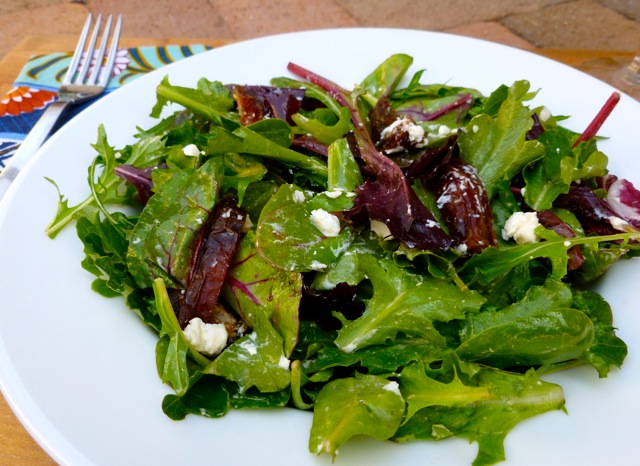
The photo above shows a savoury use: sliced dates in a green salad with crumbled cheese.
Where to buy, and what to check on the pack
Wherever you buy, at a bazaar stall, a supermarket or from an online list, the useful question is how much the seller tells you about the fruit. A wholesale supplier is the route to look at if you need larger quantities, for a cafe, a kenduri or a stack of Hari Raya gifts. Demand peaks before and during Ramadan, and Hari Raya, weddings (hantaran), kenduri and umrah gifts are other peaks, so order early for those dates.
Whatever the channel, read the label. FAO notes that in most importing countries the law requires the weight, country of origin, quality and expiry date to appear on the package. If dates are sold loose with no label, ask the seller for the origin and the variety name before you weigh out a kilo. For a longer checklist on judging a supplier, see how to judge a dates supplier. The route the fruit takes from the palm to a shop shelf is covered in this Malay piece on who handles dates before they reach you.
Storing dates at home
Storage follows the ripeness stage. Soft rotab such as Mazafati needs refrigeration, because FAO warns that rutab sours quickly without cold storage. Drier dates at the tamar stage are more forgiving: FAO says tamar protected from insects can be kept over longer periods without special precautions. Keep them in a sealed container so insects cannot get in.
FAO also notes that packing material counts during storage: cardboard is sensitive to humidity, and various plastics are sensitive to low temperatures. If you buy a 5kg pack and want to freeze part of it, move that portion into a freezer-safe container first.
Quick answers
Is rotab available outside Ramadan?
Mazafati rotab is cold-stored and sold year-round, though a given pack can still be out of stock, as the Rotab Mazafati AAA pack was in November 2026.
Is a 5kg pack always cheaper per kilo?
It was in all four pairs in the table above. Check the grade names, though, because the smaller and larger packs are often different grades.
Whether you search in English or ask around for a pembekal kurma Malaysia in Malay, the questions are the same: where is it from, what grade, how much per kilo, and is it in stock. More about this site is on the About Us page and the contact page.