

Kurma Majol is not a restaurant or a secret recipe. It is a date, and you have almost certainly seen it under its better-known spelling: Medjool. The FAO handbook on date palm cultivation lists Majul, Majhol, Majhoul and Medjoul among the synonyms for the Medjool variety. "Majol" is not on that list letter for letter, but it sits right beside two of them, and this article reads it as Medjool. What follows is a practical look at the fruit itself and what people actually do with it in the kitchen, from stuffed dates to sauces, plus what Medjool costs to buy in Malaysia right now.
Where the name and the fruit come from
The name is Arabic and, according to FAO, refers to the date's origin as "unknown". The variety itself comes from the Tafilalet area of Morocco. FAO notes that it was the principal export date there from the 17th century and was sold in gift boxes for Christmas in Paris, Madrid and London. It was later taken to the USA in 1927 and Israel in 1934. One detail in the handbook is worth repeating: all the Medjool palms in the world originated from one palm in Bou Denib, Morocco.
The Medjool in the price table further down is not Moroccan, though. Every listing there is labelled Palestine. Like every date sold here, it is imported, because Malaysia has no commercial date-growing trade.
What a Medjool date is like in the hand
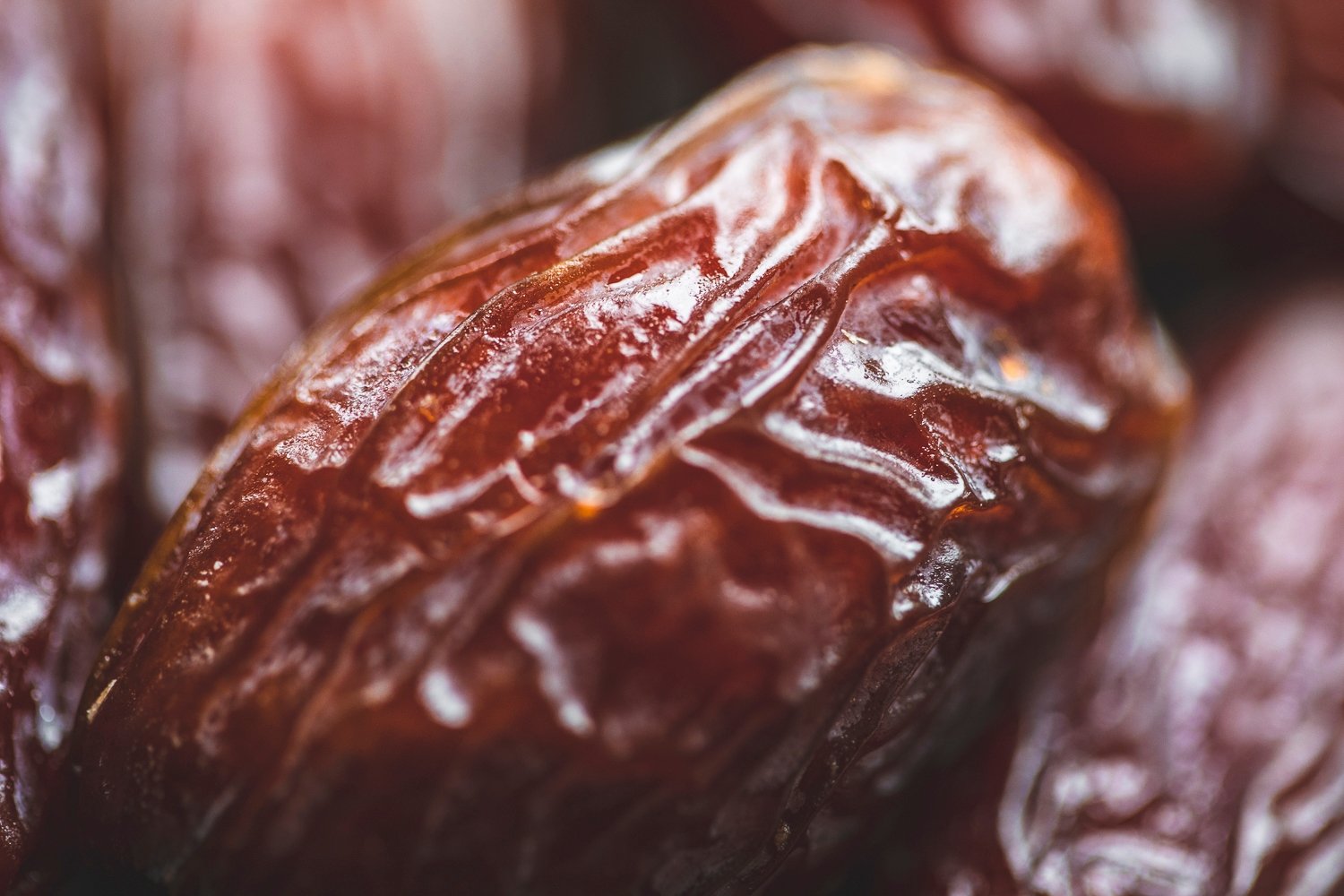
It is big. FAO describes the fruit as very large, 20 to 40 grams, about 5 cm long by 3.2 cm across, with a skin that is irregularly wrinkled. At the rutab stage it is amber. Fully ripe, at the tamar stage, it turns a translucent dark brown to black. In the hand it is large and very soft, with a rich caramel taste.
Two things you may notice on a box of Medjool are not faults in flavour. FAO names loose skin, where the skin separates from the flesh as it loses water, as "an aesthetic defect rather than a taste defect". The second is sugar crystals forming on the flesh or under loose skin, which FAO again calls an aesthetic defect. In FAO's grading description, sugar crystallising puts the fruit in Class II, and so does loose skin once more than 20 to 25% of the fruit has it. They simply look less tidy on a gift tray.
Sweet uses: from stuffed dates to fillings
Stuffing is where the size pays off. A 20 to 40 gram date has room for a whole almond, a spoon of peanut butter or a piece of cheese once the seed is out. Slit the date lengthways with a small knife, pull the seed out, press the filling in and close it loosely. That is the whole method.
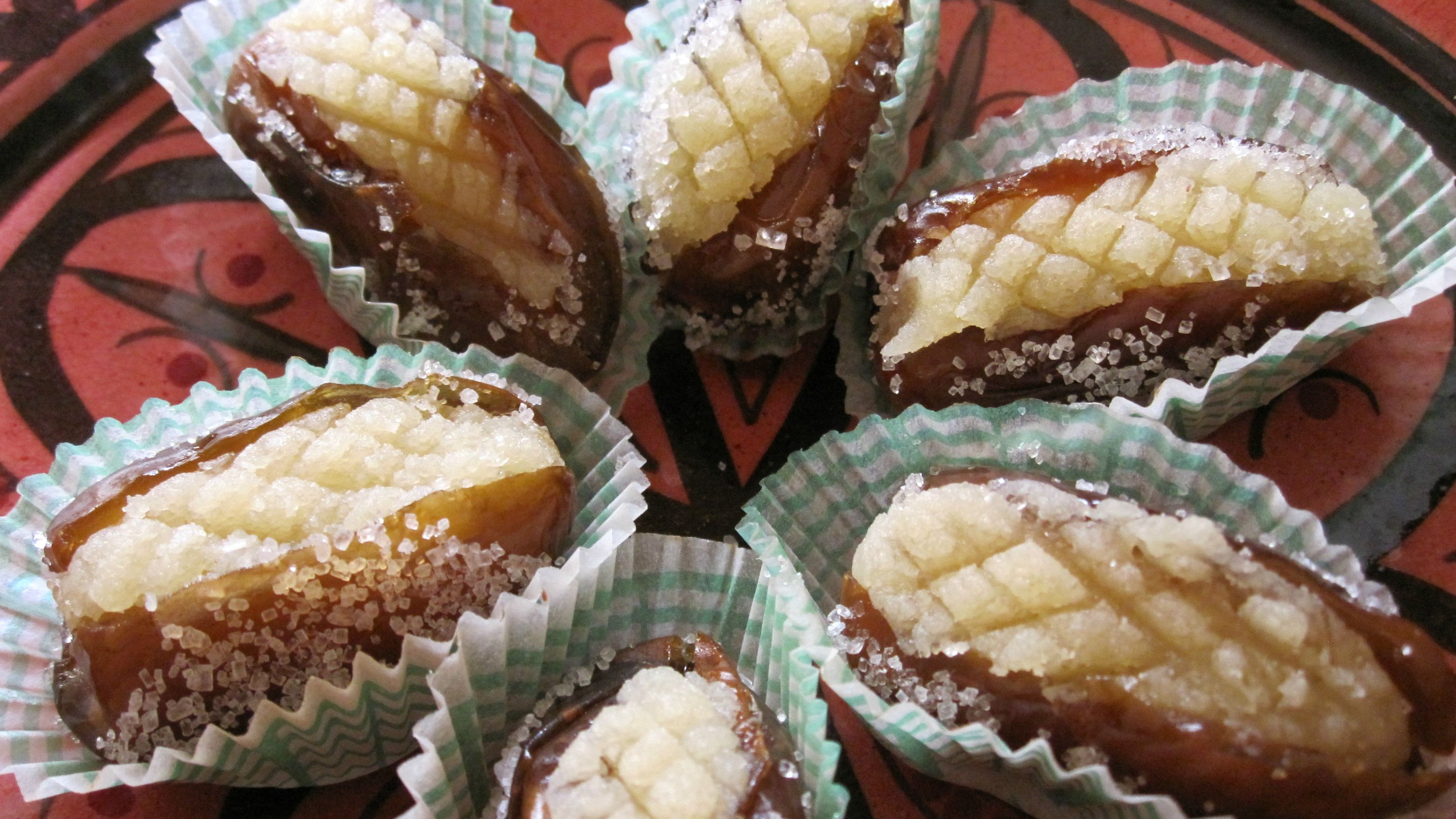
Beyond whole fruit, FAO's chapter on date products describes a few forms that most home cooks and small bakers will recognise:
- pitted pressed dates, pressed into a mould and vacuum packed, used mainly as a filling for cakes and biscuits, especially during Ramadan
- date paste, which can be used as a filling for cakes; FAO points out that its melting temperature is higher than the baking temperature, so the filling does not run out of the cake in the oven
- date syrup, sometimes called dibs or rub, used to sweeten various foods
For a home kitchen, a paste is the easy one. Soak pitted dates in a little hot water, then blend until smooth and spread it inside a roll cake or between biscuit layers. Medjool is a dear date to blend, though. In the price list further down, every in-stock Medjool listing costs more per kilo than any in-stock Ajwa, Safawi, Mariami or Deglet Noor listing from the same wholesaler, so a cheaper date may make more sense for paste.
Savoury uses: sauces and chutney
Dates are not only for dessert. FAO lists sauces for steak and chutney among date products, where the dates serve as a source of sugar and form the body of the sauce. That is a useful way to think about it at home too. Try a few chopped dates simmered with onion, vinegar and chilli until thick, for a simple sweet-sour relish to go with grilled meat.
FAO also notes that tamar-stage fruit, the fully ripe stage, is used for cakes, sauces and date honey as well as for eating whole.
What Medjool costs in Malaysia right now
If you are buying for a kitchen, a café or a small bakery, the price per kilo matters more than the price per box, whichever supplier you end up using. The table below lists the Medjool range of one Malaysian wholesaler, checked in November 2026. Names are copied as listed. Grade labels such as Large, Jumbo and Super Jumbo are each importer's own size sorting, not an international standard.
| Listing | Total weight | Price | Per kg | Stock |
|---|---|---|---|---|
| 900g Medjool Palestin Jumbo [1box] | 0.9kg | RM70 | RM77.78 | In stock |
| Medjool Palestine Super Jumbo 2026 [5kg] | 5kg | RM315 | RM63.00 | In stock |
| Medjool Palestin Jumbo 2026 - 900g * 8pkt | 7.2kg | RM448 | RM62.22 | In stock |
| Medjool Palestin Jumbo 2026 - 500gr * 12pkt | 6kg | RM355 | RM59.17 | In stock |
| Medjool Palestin Premium Jumbo 2026 [5kg] | 5kg | RM280 | RM56.00 | In stock |
| Medjool Palestin (Large) 2026 - 250gr * 24pkt | 6kg | RM355 | RM59.17 | Out of stock |
| Medjool Palestin Large 2026 - 5kg | 5kg | RM250 | RM50.00 | Out of stock |
| Medjool Palestine Large - 8pkt * 1Kg | 8kg | RM394 | RM49.25 | Out of stock |
| Medjool Palestine Jumbo- 12pkt * 500Grams | 6kg | RM290 | RM48.33 | Out of stock |
Comparing one supplier's list with another is easier once everything is per kilo. Among the listings in stock, prices run from RM56 a kilo for the 5kg Premium Jumbo carton to RM77.78 a kilo for the single 900g box. Every Large listing was out of stock when checked. For a café or bakery that uses Medjool whole, that gap between a single box and a carton is the number to plan around. If you are searching for a pembekal kurma Malaysia to quote you, ask any supplier for the net weight, the grade label and whether it is in stock now, so you can work out the per-kilo price yourself.
If you want to understand who handles the dates between the farm and the shop shelf, we wrote about that in who handles kurma before it reaches your shop.
Other dates for the same kitchen
Medjool is not the only date worth cooking with. Safawi, from the Madinah region, is longer than Ajwa, dark brown to black, soft and chewy. Our notes on the Safawi flavour profile go further into it. Mariami from Iran is a dark, semi-dry, chewy date, and there is a separate post on buying Mariami online. More posts are listed on the blog page.
Questions people ask about kurma Majol
Is kurma Majol the same as Medjool?
FAO lists Majul and Majhol among the synonyms of Medjool, and Majol sits between those spellings. This article treats them as the same date.
Are sugar crystals on Medjool a sign it has gone bad?
FAO describes sugar crystallising on Medjool as an aesthetic defect, one that puts the fruit in Class II. It is about appearance in FAO's grading.
Which Medjool listing is cheapest per kilo?
In the November 2026 list above, the in-stock 5kg Premium Jumbo carton works out lowest at RM56 a kilo. That is a useful figure to hold up against any other supplier's quote.
More about this site is on the About Us page and the contact page.